lasuconscience
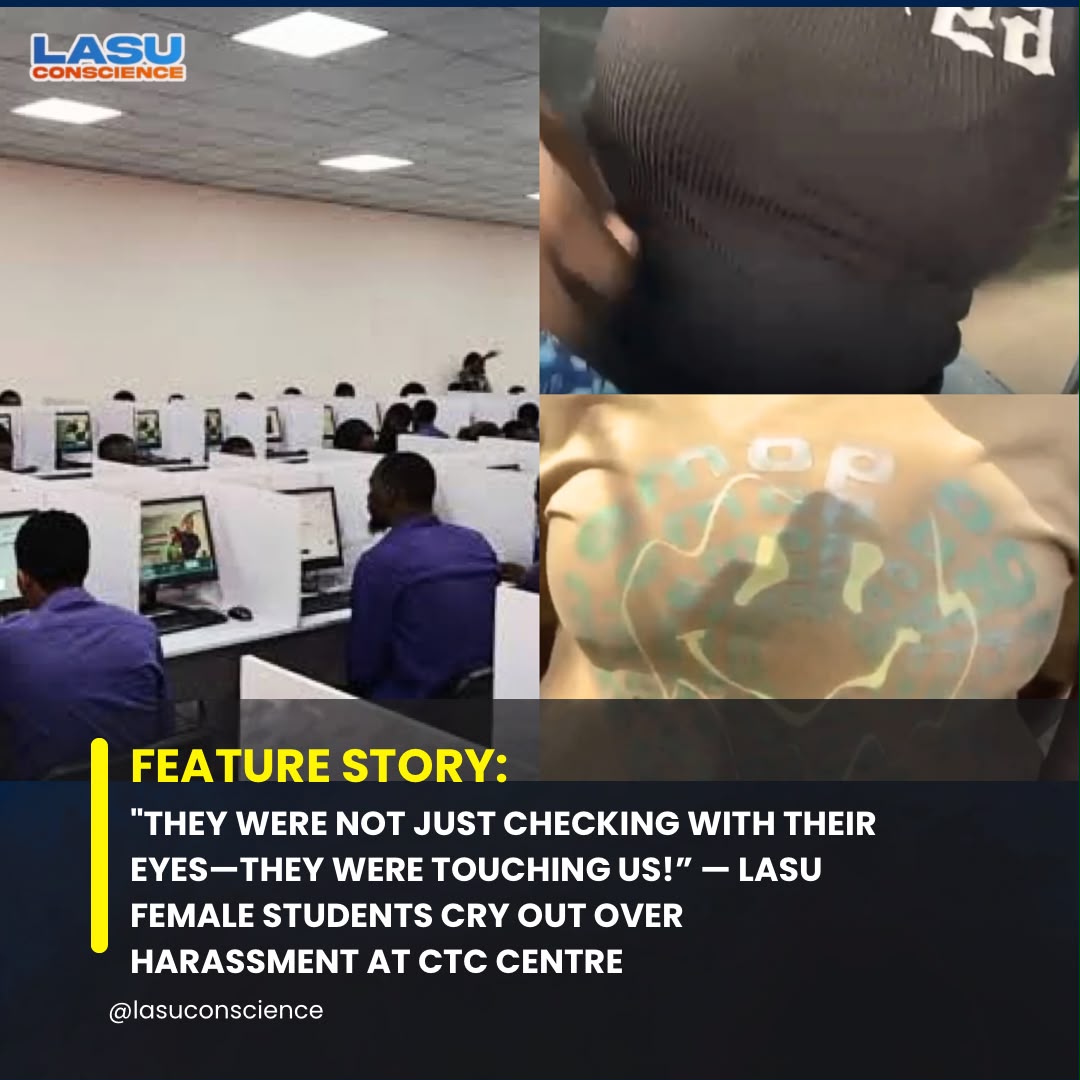
The tension that comes with examinations is familiar to every university student. But for a growing number of female students at Lagos State University (LASU), the fear of failing an examination has recently been accompanied by another anxiety—the possibility of being stopped at the entrance of the examination hall, physically checked and publicly questioned over whether they were wearing a bra before being allowed to sit for their papers.
What should normally be a routine security and identity screening has, according to interviews with affected students, become an experience many describe as humiliating, intrusive and, in some cases, academically costly. An investigation by LASU Conscience found that complaints first raised during the first semester examinations have resurfaced this semester with greater frequency, with several students alleging that prolonged body checks and disputes over compliance with the university’s dress code delayed their entry into CBT halls, eventually causing some to miss scheduled examinations altogether.
While Lagos State University maintains a dress code intended to promote decency within the institution, interviews with students suggest that the manner in which aspects of the policy are being enforced, especially during examinations, has become a growing source of concern. Rather than questioning the existence of the dress code itself, many students are asking whether its enforcement has become inconsistent, invasive and capable of denying students the opportunity to sit for examinations they have prepared for over an entire semester.
STUDENTS’ UNPLEASANT EXPERIENCES AT THE CTC CENTRE
For many of the students interviewed by LASU Conscience, the issue was never about resisting the university’s dress code. They insist they complied with the institution’s expectations of decent dressing. What they found difficult to comprehend, however, was why the enforcement of that code allegedly involved physical contact, public scrutiny and prolonged delays that threatened their academic future.
One of the students, a 200-level undergraduate who requested anonymity for fear of victimisation, recalled how what should have been an ordinary examination morning on Tuesday, June 23 turned into one of the most distressing experiences of her academic life.
She had arrived at the CTC venue alongside dozens of other students to write MUS 254, however, she said that on her way into the CTC, she and several other female students were stopped by a group of women stationed at the entrance and accused of not wearing “appropriate” bras.
“They were rubbing our backs and touching our breasts, trying to feel for the hook of the bra,” she recounted. “Most of us were wearing sports bras or tube bras. It wasn’t as if we weren’t wearing bras at all. But because there was no hook at the back, they insisted we were improperly dressed.”
According to her, every attempt to explain that different types of bras exist was dismissed.
“They wouldn’t listen. They started shouting at us and insulting us. They even said we should go and call the parents who failed to train us.”
According to her, the experience was not over as the officials allegedly confiscated the students’ examination dockets, handed them disciplinary forms and directed them to the Students’ Affairs Division, despite their examination already in progress.
She recounted the encounter as deeply humiliating and traumatising.
“There were male students everywhere looking at us while all this was happening. Imagine being surrounded by people while someone is touching your chest and accusing you of not wearing underwear. I have never felt so embarrassed.”
According to the student, the physical checks were not limited to her.
She alleged that one female student had her jacket opened and the scarf wrapped around her body removed in full view of male students after officials demanded to inspect what she was wearing underneath.
“She was exposed in public,” the student alleged. “The woman even pointed at her innerwear for other people to see. There were men standing there.”
The students were eventually escorted to the Students’ Affairs Division, where they were instructed to complete disciplinary forms and provide academic documents.
Ironically, according to the interviewee, officials at the division did not appear to consider their dressing inappropriate.
“They looked at us and didn’t see anything wrong,” she said. “But by then, our examination had already started.”
Determined not to lose an entire semester’s work, the students hurried back to the examination venue. Yet, according to the interviewee, many still faced resistance before eventually being allowed into the CBT hall.
By the time she gained access, she said, only a few minutes remained.
“I entered the hall with about three minutes left to answer 30 questions. There was no way I could finish the examination.”
Others, she added, were not as fortunate.
“Some students couldn’t write the examination at all. Some even missed their GNS examination because of the delay.”
Even after the examination ended, the ordeal was far from over.
The officials who had confiscated their dockets allegedly refused to return them, forcing the students to remain on campus for several more hours while seeking intervention from the Dean of Student Affairs.
According to the student, it was only after the Dean personally listened to their account, concluded that there was nothing inappropriate about their dressing and instructed members of his staff to retrieve the confiscated documents that the dockets were eventually released.
“Even then, they still didn’t want to give them back,” she said. “It was only after they realised the instruction came directly from the Dean that they finally released them.”
The accounts gathered by LASU Conscience suggest that not every student experienced physical searches. Yet, even those who did not described an atmosphere they considered intimidating, degrading and, at times, arbitrary.
Another student, who spoke on condition of anonymity, recalled arriving at the CTC for a MUS 254 examination expecting nothing more than the routine process of waiting to be ushered into the CBT hall. Instead, the student said a brief conversation with another candidate in the waiting area unexpectedly drew the attention of one of the officials on duty.
Without any prior warning, the official allegedly instructed the student to stand up before ordering the student to leave the row and “go to the back and marry the wall”—an expression commonly used to mean standing alone while facing a wall.
“I didn’t understand why I was being singled out,” the student recalled. “Other people were talking too, but I was the one asked to leave where I was sitting. I came to write an examination, not to be treated like a child.”
The student said the instruction felt particularly humiliating because several classmates were present.
“I felt embarrassed. I just kept wondering why it had to happen in front of everyone.”
According to the student, hesitation to immediately comply was met with further warnings.
“He told me that whatever rights I thought I had, I would come and prove them to him.”
The student further alleged that entry into the examination hall was delayed for several minutes as other candidates who had been seated nearby were allowed to proceed first.
“In the end, I apologised because I didn’t want anything to stop me from writing my examination.”
The same student also recounted witnessing another encounter days earlier while leaving a Yoruba examination.
According to the student, an official stopped a female candidate over allegations that she was not wearing what the official considered an appropriate bra and demanded her mother’s telephone number.
“The next thing they wanted to do was call her mother to report that she wasn’t wearing a bra,” the student said. “Watching it happen, it just felt unnecessary. It was really disheartening.”
Although the student was not directly involved in that encounter, the incident, according to the interviewee, reflected a growing concern among candidates that examination screening had become a source of fear in itself.
For another female student, what was supposed to be the final examination of the semester ended in tears, anxiety and the loss of an examination.
The student said she had arrived at the CBT centre well ahead of her scheduled paper, having deliberately dressed in a way she believed complied with the university’s dress code.
“I made sure everything was covered because I didn’t want anyone to disturb me,” she recalled. “I even tied a scarf because I didn’t want anybody to have an issue with my hair. I wasn’t expecting to be stopped that day.”
After joining other candidates waiting to enter the examination hall, she said an official called her back, briefly touched her back and alleged that she was not wearing a bra.
“I was wearing a tube bra with foam underneath thick clothing. Nothing was showing, my cleavage wasn’t exposed, so I didn’t understand where it was coming from.”
She said she tried to explain that she was properly dressed but felt her explanation was dismissed.
“If this had become a rule, they should have informed us earlier or at least given us a warning. Nobody told us anything. They were only concerned about bras.”
As the delay continued and the time for her examination drew closer, she said she became overwhelmed.
“I just sat down and cried. I was already having anxiety because I was too shocked to even know what to do.”
According to her, the situation escalated into a panic attack, forcing her to seek medical attention at the university health centre before attempting to return for her examination.
By the time she logged into the CBT portal shortly before 1 p.m., she said the examination had already closed.
“I called the lecturer to explain what had happened, but I was told the exam was already over. I kept asking myself why I should pay for someone else’s mistake when I hadn’t done anything wrong.”
Unable to contain her emotions, she broke down outside the examination venue.
“I didn’t just cry—I wept,” she said. “It was a borrowed course, and I had never borrowed a course before. I started blaming myself, thinking if I had known this would happen, I wouldn’t have taken the course. It was so painful, and it took me a long time to recover from the shock.”
Another student, Jane (not real name), recounted a similar experience:
“It happened on the day we had the Music exam. When I got to the exam hall, one of the examiners sent me back, claiming I wasn’t wearing a bra. I tried to explain to her that I don’t have big breasts, I wasn’t wearing any revealing clothes, and my breasts weren’t protruding through my outfit. I was wearing a white top and a pair of jeans.
“She didn’t listen to anything I had to say. Instead, she told me to collect a disciplinary form. I refused to leave the premises because I couldn’t find anything wrong with what I was wearing. This was the same CTC where I had been writing my examinations since my 100 level, yet I was stopped from writing my exam that day.
“While others followed a staff member to the Students’ Affairs Division, I stayed behind, trying to understand what my offence was. When no one could answer me, I eventually went to the Students’ Affairs Division to join the others and filled the form. We were there for about two hours.
“One of the officials at the Students’ Affairs Division even said they didn’t know what offence to charge us with because we hadn’t done anything wrong. After we filled the form, we were told it would reflect on our records and that half of our lives were already in LASU’s hands because the university could use the form against us at any time.
“When we returned to the CTC to write the examination, we were told that the exam had already ended, and the security officials chased us away. About 30 minutes later, we were called back to write the examination, but we were given only three minutes to answer the questions. That wasn’t enough time, and some students still missed the examination entirely.”
The accounts gathered by LASU Conscience suggest that the controversy did not begin this semester. Similar experiences were reported during the first semester examinations, with one student recalling an encounter that has continued to affect her months later.
“I was going in to write my examination when I noticed there was a group of women at the entrance. Suddenly, they separated the female students from the male students and started checking our breasts.
“They were not just checking with their eyes—they were touching us. They said they wanted to make sure we were wearing bras before entering the CTC.
“One of the women touched my breasts, realised I wasn’t wearing one, then pinched me, insulted me and urged me to keep moving.
“I was dressed in a pair of jeans and a basic top.
“I can’t really remember the examination I wrote that day because it happened last semester, but I remember the experience clearly. A lot of us went through it that day, and I’m still traumatised.”
Another female Muslim student shared her unpleasant encounter: “I’m a 200-level student, and that faithful morning I was scheduled to write a CBT examination at the CTC.
“As we entered the Buba Marwa Hall, a male supervisor kept saying, ‘If you know you aren’t wearing a bra, go home or you won’t be allowed to write the exam. You can’t come here and start seducing people. This isn’t a motel.’
“It was the last paper, and everyone laughed after the announcement, but I didn’t find it funny because why would something like that be announced in that manner?
“My rage increased as I walked towards the main examination hall. I’m a chubby girl and a Muslim. I was wearing a gown and my hijab, only for me to be stopped, and a lecturer said in Yoruba, ‘Is this girl wearing a bra like this?’
“Instantly, I felt embarrassed and irritated. She moved closer to me and started touching my back in a way that I found very molesting. After that, she said, ‘Ó wo,’ meaning I was wearing a bra.
“The guys in the hall started laughing, and I felt disgusted.
“Firstly, I found it unnecessary. I found it annoying. I found it uncomfortable. I found it molesting. People kept laughing, but I don’t know why they found it funny. I didn’t find it funny at all.
“I just shook my head and walked into the examination hall in embarrassment. I’m very sure I wasn’t the only victim. Others might have found it funny while it was happening, but I kept saying to myself, ‘This is really, really wrong.'”
Recounting these recurring incidents at the LASU CTC Centre, it is evident that many students of Lagos State University are unhappy, distressed, and increasingly traumatized by what they describe as persistent harassment from some members of staff under the guise of enforcing the institution’s dress code. While some staff members maintain that the affected students violated the university’s regulations on decent dressing, many students argue that the very need to touch or physically inspect their bodies suggests that their outfits were not as visibly indecent or immoral as alleged. Beyond the physical intrusion, students say they feel humiliated, violated, and betrayed by an institution they believe should protect their dignity rather than subject them to experiences they perceive as degrading.
We at LASU Conscience urge the management to kindly look into these issues and see that justice and balance is carried out. And most importantly: students who missed their exams due to these cases are addressed accordingly.


 Zaynab Openiyi, Editor, LASU Conscience

 Iyanu Sogbesan, Correspondent, LASU Conscience