lasuconscience

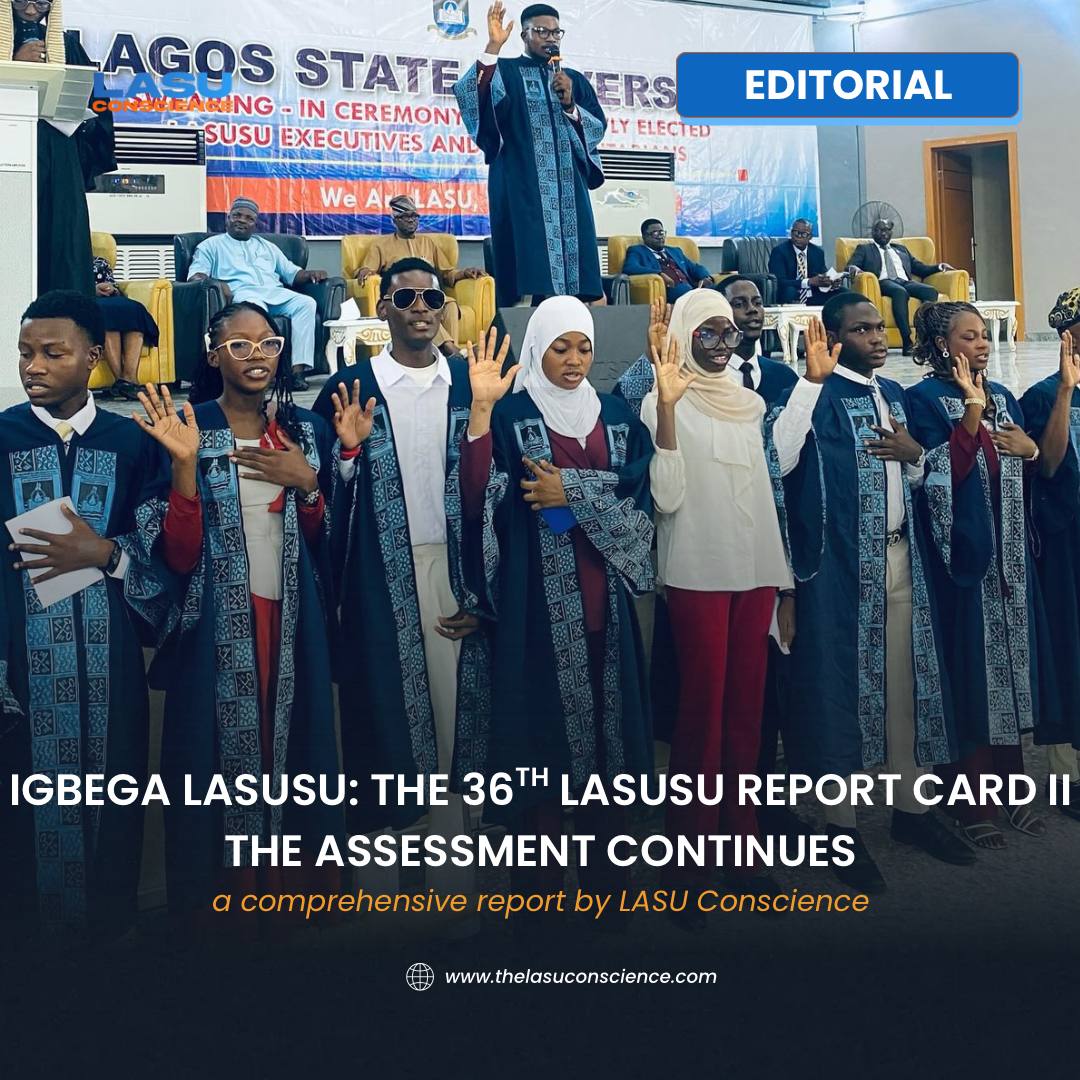
A session under the 36th LASUSU administration, “Igbega LASUSU,” has drawn to a close, and with it comes the responsibility of asking the questions that matter: what was promised, what was delivered, and where did students get left behind? This administration governed through a period defined by economic hardship, recurring security scares, and a student population that grew increasingly impatient with silence from the very people elected to speak for them.
In this first instalment, we examine the Presidency, the Vice Presidents of Ojo, Ikeja and Epe, the Secretariat, and the Social Director, the offices whose visibility, or lack of it, shaped how students experienced this administration.
COMRADE ADEBAYO KOREDE PETER (APK) — PRESIDENT
The office of the President is undoubtedly the highest office in LASUSU. Beyond being referred to as the “Number One Student,” the LASUSU constitution charges the President to coordinate and harmonize the activities of the Students’ Executive Council, represent students before university management and external bodies, and above all, protect the interests of LASUites.
Every administration is remembered for something. Some are remembered for groundbreaking initiatives; others are remembered for how they responded when things fell apart. As the curtain gradually falls on the 36th LASUSU administration under Comrade Adebayo Korede Peter, one question lingers: what exactly will students remember this administration for?
To be fair, APK did not completely distance himself from the issues that mattered. There were moments he showed up, moments he spoke, moments he intervened. But showing up is only the opening line of leadership, not the whole story.
One incident that will remain fresh in the minds of many students was the tragic death of Azeezat, a 300-level student who lost her life in April 2026. The unfortunate incident threw the university community into mourning and generated widespread calls for justice. To the administration’s credit, the President, alongside the Welfare Director, responded promptly, visiting the bereaved family and publicly demanding that justice be served. In that moment, many students believed the Union would remain at the forefront of ensuring the matter did not die a natural death.
However, after the initial intervention, what happened?
Students who were assured that justice would prevail received little or no meaningful update afterward. As weeks turned into months, the administration gradually went silent, leaving many wondering whether the pursuit of justice had also come to an end. Leadership does not end after a press statement is issued. It continues until the people being represented know how the story ends.
Another test came in the form of the campus shuttle crisis. At the start of the second semester, students endured long queues, an inadequate number of buses, and uncertainty around transportation on campus. Following complaints, the Union intervened and negotiated the proposed shuttle fare down from ₦200 to ₦150. On paper, this was commendable. In reality, it was only half the job. Despite the agreement, many students continued paying ₦200, as operators routinely claimed they had no ₦50 change, leaving some students stranded and others forced to pay above the approved rate. LASU Conscience’s independent investigation exposed this recurring problem, yet it persisted.
What, then, is the value of a directive without enforcement? Negotiating a price is one thing; ensuring compliance is another. Student leadership should not end at the point of announcement, it should extend to monitoring implementation and protecting students from exploitation.
The administration also had a chance to show proactive leadership during the rollout of the NELFund Student Loan Scheme. For many beneficiaries, the scheme was meant to ease the burden of school fees. Instead, it became another source of anxiety, with complaints of incomplete fee payments, non-disbursement of funds, and unpaid upkeep allowances piling up. While complaints grew, the administration’s last major public update on the matter simply told students disbursement had commenced and to monitor their portals, a response that did little to address the concerns of students whose NELFund portals showed successful payment while their LASU fees portal remained unpaid, or who had received nothing at all.
It was only after LASU Conscience published an editorial highlighting these concerns that more visible efforts appeared to resolve the issue, with affected students eventually directed to submit letters at the Senate Building. But the question lingers: should students have to rely on media intervention before receiving the attention they deserve? Student leadership is expected to anticipate problems before they become crises, and while the eventual intervention deserves recognition, the delay left many beneficiaries feeling abandoned during a critical academic period.
Perhaps the most consistent thread running through this administration was the communication gap. Whether the issue was school fees, course registration, NELFund, or security, students repeatedly relied on unofficial information, forwarded messages, and departmental grapevines to understand matters that directly affected them. The Union was often perceived as reacting to pressure rather than communicating ahead of it. While communication is typically associated with the office of the Public Relations Officer, responsibility for governance does not rest on one office alone, as head of the Executive Council, the President bears the ultimate responsibility for ensuring students receive timely information.
At different points, questions around accountability within the Executive Council also generated uncertainty, with matters requiring official clarification sometimes left unanswered, creating room for speculation and unnecessary confusion. Leadership requires openness, particularly when students are directly affected by developments within their own Union.
This is not to suggest the administration achieved nothing. APK remained visible during some critical moments and represented students on several occasions. But visibility alone is not enough. Students expect representation that is consistent, communication that is timely, and interventions that continue beyond the first announcement.
One initiative from the President’s office worth acknowledging is the LASU Worship Experience, a gathering that brought believers together on campus to worship. On the surface, it is the kind of programme that speaks to the spiritual wellbeing of the student community, and there is nothing wrong with a Union that recognizes that students are not just academic or financial beings, but spiritual ones too.
However, one detail from the event’s publicity is difficult to overlook. Among the partners publicly announced for the Worship Experience was Black Stallion, an energy drink brand widely marketed and understood within Nigeria as an alcoholic beverage. This raises an uncomfortable but necessary question: why would an alcoholic drink brand be a partner for a religious gathering meant to draw students closer to God? Of all the brands that could have been approached to support a worship programme, why Black Stallion? Sponsorship decisions are not made in a vacuum, and for an event built around faith and worship, the choice of partner matters just as much as the programme itself. Students are entitled to ask whether due diligence was done before this partnership was sealed, and whether anyone in the President’s office paused to consider the message it sends when a gathering meant to preach the gospel is seen publicly branded alongside alcohol.
Beyond this specific episode, it points to a broader gap: the office does not appear to run every partnership or endorsement through any visible vetting process before a brand’s name is attached to a Union programme, whether religious, social or academic. The incoming President would do well to institute a simple internal check — who is this brand, what do they represent, and does this fit what the event stands for, before any sponsor’s logo goes up on a flyer bearing the Union’s name.
To the incoming President, this report card offers a simple reminder: students deserve more than promises and public appearances. They deserve leaders who communicate consistently, enforce the decisions they make, follow through on every intervention, and remain accountable throughout their time in office. That is the standard every administration after this one should be measured against.
LASUSU REPORT CARD: THE VICE PRESIDENTS
The office of the Vice President exists to complement the work of the President while ensuring that students across Ojo, Epe and Ikeja have representatives who understand and respond to the peculiar realities of their respective campuses. Their duty goes beyond attending executive meetings or appearing at Union programmes, the constitution expects them to assist the President in the performance of his duties, remain accessible to students, identify campus-specific concerns, work with other executives to resolve them, and communicate the progress of such interventions.
For the 36th administration, Comrade Abisuga Moyosoluwa served as Vice President, Ojo; Comrade Adewole Yazir Adeyemi served as Vice President, Ikeja; while Comrade Azeez Wasiu served as Vice President, Epe.
ABISUGA MOYOSOLUWA — VICE PRESIDENT, OJO
Of the three Vice Presidents, Comrade Abisuga Moyosoluwa has the most publicly visible record of activity. Her office was associated with a number of student-focused academic and intellectual programmes, including the Freshers’ Induction Summit, which sought to help newly admitted students navigate university life beyond the classroom, complete with an Inter-Faculty Freshers’ Debate designed to sharpen public speaking and critical thinking.
Her office was also involved in the My Book & I Tutorial, an initiative aimed at providing academic support to students, and an Education Expo organized in partnership with Avail Education. Another notable initiative was the Global Dialogue Intervarsity Debate, run in partnership with the LASU Debate Society and supported by Lift Travels, which brought students from different universities together and offered ₦1 million worth of cash and gifts as its grand prize. She also featured in LASU Xperience, where members of the 36th administration engaged freshers on navigating university life.
For these efforts, the office deserves its flowers. However, visibility through programmes is only one half of representation. The bigger test for a Vice President is whether students can point to the office when discussing their welfare, academic, financial, security, or campus-specific concerns, and here, the public record contains considerably less evidence of sustained intervention. This does not necessarily mean such engagement never happened behind closed doors, but it suggests more could have been done to communicate those efforts to the students they were meant to serve.
There is, however, a more troubling matter attached to one of the office’s flagship programmes, one LASU Conscience has already reported on in detail . The Global Dialogue Intervarsity Debate, hosted by Abisuga’s office on April 29, 2026, drew debaters from institutions beyond LASU and announced a ₦1 million prize purse. Four months on, the winners are still waiting to be paid. The Vice President has attributed the delay to the University Management’s failure to release the funds and maintains she has continued to follow up with the Bursary, but for students and outside institutions alike, the fact remains that a public promise has gone unfulfilled for months.
To be clear, Abisuga’s office recorded visible, well-organized initiatives across the session, particularly in academic and intellectual engagement, and deserves credit for that. But an unpaid ₦1 million prize purse, sitting unresolved for months with no firm payment date, is not a footnote, it is the kind of broken public commitment that quietly erodes the very credibility those academic programmes were meant to build. The lesson for whoever inherits the Ojo Vice Presidency next is simple: before a prize purse is announced publicly, the money behind it should already be secured, not pending an approval chased after the fact.
ADEWOLE YAZIR ADEYEMI — VICE PRESIDENT, IKEJA
Comrade Adewole Yazir Adeyemi served as Vice President representing Ikeja Campus. Unlike his Ojo counterpart, there is limited publicly accessible documentation from which specific programmes or interventions can confidently be attributed to his office, perhaps one of the most important observations to come out of this review.
The absence of public documentation should not automatically be read as an absence of work; a considerable part of Union administration happens through meetings, consultations and engagements with university authorities that never make it to a timeline or a press release. Still, students cannot assess what they cannot see. A campus representative should make it relatively easy for students to know what their office is doing, what issues have been raised on their behalf, and what progress has been made.
One issue in particular deserves direct mention. Ikeja Campus has, over the course of this session, grappled with a noticeable hike in rent prices, pushing many LASUCOM students into increasingly uncomfortable and unstable living arrangements. This is precisely the kind of campus-specific crisis the Vice Presidency exists to respond to, in coordination with the Welfare Director. Yet there has been no publicly visible sign of the Vice President working alongside the Welfare Director to confront the issue, no update on engagement with landlords or property owners in the area, and no indication that the office pushed for any form of relief or intervention on behalf of affected students. For a crisis this tangible, silence is not a neutral position.
The incoming Ikeja Vice President should treat this as unfinished business rather than a fresh start. A working relationship with the Welfare office, a documented engagement with landlords or the local community on fair pricing, and periodic public updates on housing conditions would go a long way toward restoring the sense that someone is actually watching Ikeja students’ backs.
Adewole’s record, based on what is publicly verifiable, therefore calls less for condemnation and more for a stronger culture of visibility, communication and accountability going forward. The Ikeja Vice Presidency should not wait until the end of a tenure before students begin asking what was actually achieved, and it certainly should not wait until rent has become unbearable before it decides to speak.
AZEEZ WASIU — VICE PRESIDENT, EPE
Comrade Azeez Wasiu served as Vice President representing Epe Campus. His participation in LASU Xperience, where he joined other members of the 36th administration in addressing freshers and encouraging them to embrace their abilities and pursue their aspirations, provides one of the clearer publicly documented engagements associated with his office, and his identification with the Epe Vice Presidency is well established in LASUSU’s official publicity.
Beyond such Union-wide engagements, however, there is limited publicly available information detailing specific Epe-focused interventions personally attributable to his office. This matters because Epe is not simply another location within LASU, students there face their own peculiar realities, and effective representation requires understanding them. The Vice President should be among the first officers a struggling Epe student can approach, and should be able to carry that concern to the appropriate office and return with updates.
This gap is felt most sharply on the very issues that make Epe Campus distinct from Ojo and Ikeja. Reports throughout the session pointed to persistent electricity problems on the campus, with some students describing stretches of over a month without light, alongside ongoing complaints about the state of housing and basic facilities. These are not minor inconveniences; they go to the heart of whether students on that campus can live and study with any measure of dignity. Yet there has been little to no publicly visible push from the Vice President’s office demanding answers from the relevant authorities, or even keeping Epe students updated on what, if anything, was being done about it.
Again, this is not proof that no work was done, it is a reflection of what students and the public can currently verify. The office had identifiable participation in Union-wide engagement, but there remains insufficient public evidence of sustained, campus-specific advocacy for Epe students, particularly on the electricity and housing concerns that have gone unresolved for far too long. It is worth noting that this is not a burden the Vice President carries alone, the Welfare Director for Epe shares direct responsibility here too, a point we will return to when this report card turns to the welfare offices.
Epe cannot keep being the campus that gets remembered last. The incoming Vice President for Epe should prioritize a direct, documented line of engagement with the university’s facilities and works departments over the persistent power and housing issues, and should not wait for a crisis to escalate before Epe students hear from their own representative.
THE BIGGER PICTURE: THREE VICE PRESIDENTS, ONE RESPONSIBILITY
Although the three Vice Presidents represent different campuses, their core responsibility remains identical: ensuring students are represented, heard, and responded to. This review shows a clear gap in the amount of publicly documented activity across the three offices, the Ojo Vice Presidency carries a noticeably stronger public record, particularly in academic and intellectual affairs, while the Ikeja and Epe Vice Presidencies leave considerably less for students to point to.
This does not necessarily mean work was not done behind the scenes, but limited documentation makes it difficult for students to fairly assess impact, and fairness, after all, cuts both ways, an office cannot be praised or condemned for what is never made visible.
The next administration needs a stronger system of campus representation, one built on accessibility, communication, documentation and collaboration. Vice Presidents should not operate as isolated ambassadors of their campuses, but as active members of the Executive Council working with the President, PRO, welfare officers and other executives to move students’ concerns from identification to actual intervention. Ultimately, the effectiveness of a Vice President should be measured not by visibility alone, but by whether students can clearly identify the difference their representation made.
THE SECRETARIAT
The Secretariat serves as the administrative backbone of the Students’ Union, with responsibilities ranging from documentation and correspondence to coordination and follow-up on Union matters. For the 36th administration, Comrade Ibikunle Ayotunde served as General Secretary, alongside Comrade Ismail Azeezat Fortune as A.G.S., Ojo; Comrade Lawal Samuel Temidayo as A.G.S., Ikeja; and Comrade Mafiweze Elizabeth Biroluwa as A.G.S., Epe.
IBIKUNLE AYOTUNDE — GENERAL SECRETARY
As the chief administrative officer of the Union, the General Secretary is expected to maintain records of meetings and resolutions, handle official correspondence, and ensure decisions reached by the Executive Council are properly documented and followed through, much like the “main main” behind the scenes that the office has historically been known for.
Under the 36th administration, the Secretariat operated through a structure that also provided representation across Ojo, Ikeja and Epe, giving students across the campuses a channel to route their concerns. However, administrative presence alone is not the full job. With LASUites facing everything from NELFund delays to course registration, clearance, electricity and security concerns, the Secretariat’s performance should also be measured by how effectively such issues were documented, escalated, and followed up and here, the office would have benefited from greater visibility around the outcomes of its engagements. For students, knowing an issue has been raised is only the beginning; they also need to know what action followed.
Ayotunde’s tenure leaves an important lesson for whoever inherits the pen next: effective secretarial leadership requires not only keeping records, but ensuring that decisions and student concerns are followed through to measurable, visible outcomes. A simple, regularly published tracker of issues raised, escalated and resolved even a basic one would do more for student confidence in the Secretariat than any amount of behind-the-scenes diligence that nobody outside the SEC ever gets to see.
ISMAIL AZEEZAT FORTUNE — A.G.S., OJO
As Assistant General Secretary representing Ojo, Ismail Azeezat Fortune formed part of the administrative structure supporting the General Secretary, a position designed for closer engagement with students and the channeling of campus-specific concerns into the Union’s administrative processes.
However, there is limited publicly accessible information from which specific interventions can confidently be attributed to the office. This does not necessarily mean no work was done, as several Union engagements take place outside public view, but stronger documentation and communication of campus-level interventions would have made the office’s impact far easier for students to assess.
LAWAL SAMUEL TEMIDAYO — A.G.S., IKEJA
Comrade Lawal Samuel Temidayo served as Assistant General Secretary representing Ikeja. Like the other A.G.S. offices, the position was designed to strengthen the Secretariat’s reach and give students outside the main campus a channel through which their concerns could reach the Union.
However, publicly accessible records provide limited evidence of specific interventions directly attributable to the office. The challenge for the incoming administration is to make campus-level secretarial representation more visible, through regular consultations, documented concerns, and updates on the progress of issues raised by students.
MAFIWEZE ELIZABETH BIROLUWA — A.G.S., EPE
Comrade Mafiweze Elizabeth Biroluwa served as Assistant General Secretary representing Epe, providing another layer of representation within the Secretariat and expected to ensure that the concerns of Epe students were adequately captured within the Union’s administrative structure.
However, as with the other A.G.S. offices, there is limited publicly accessible documentation through which the specific impact of the office can be comprehensively assessed a pattern that, by this point in the review, has become impossible to ignore.
The 36th LASUSU Secretariat had a structure capable of providing administrative coordination and representation across Ojo, Ikeja and Epe. Its public record, however, leaves considerable room for greater visibility of its interventions, follow-up, and outcomes. The incoming administration should build a Secretariat that does more than document meetings and correspondence, one that tracks issues, follows up on resolutions, communicates outcomes, and lets students see the progress of matters raised on their behalf. For the three incoming A.G.S. officers specifically, something as simple as a monthly campus bulletin summarizing concerns raised and their status would turn an otherwise invisible office into one students can actually hold accountable.
COMRADE AROMIRE MUIZ AKA NOVA — SOCIAL DIRECTOR
When Comrade Aromire Muiz, popularly known as NOVA, stepped into office as Social Director of the 36th administration, he did so with massive hype, high energy, and heavy expectations from the student populace. According to the LASUSU constitution, the mandate of the office is unambiguous, the Social Director shall “organize and coordinate all social and cultural activities of the Union.” Over the course of his tenure, this office has consistently been associated with some of the most anticipated events on campus like Mr/Miss LASU Freshers, Costume Day, Mr/Miss LASU, and Ojude LASU, events that have proven to be about more than entertainment, contributing meaningfully to how memorable the campus experience is for students.
To his credit, NOVA did not shy away from putting his name on big-ticket programming. Over the course of his tenure, he organized the Mr. & Miss LASU Freshers pageantry at the university’s main auditorium, the LASU Dinner and Award Night, and the LASU Costume Day at the Students’ Arcade. On a checklist, the calendar looks full.
But LASUSU has always had a culture of hosting these kinds of events and pulling real crowds for them, that is the baseline, not the achievement. Measured against that standard, this administration’s Social Directorate was the weakest in recent memory. None of NOVA’s events drew the kind of turnout the calendar of a Social Director is supposed to command, and the gap was stark enough that students openly began comparing him, unfavourably, to his predecessor. For long stretches of the session, the office’s absence was simply everywhere, students unaware an event was even happening, or finding out only after it had come and gone. Where, exactly, was the social life this office exists to build?
The Costume Day held on Tuesday, March 24, is the clearest case study. Widely regarded as one of the campus’ most anticipated social events, it reportedly drew fewer than 300 students in attendance, out of a student population running into the thousands. What is the essence of an event when barely 5% of the student body is even aware it is happening?
This prompted LASU Conscience to publish an editorial call-out titled “Where is the Social Director? A Wake-Up Call to Rekindle Social Inclusivity”, drawing a pointed comparison to his predecessor. The 35th Social Director, widely known as Leon, had his own shortcomings, but his tenure was marked by consistent activity and visibility, events were frequent, publicity was widespread, and there was a clear, deliberate effort to carry the wider student body along, with events like Ojude LASU executed at a scale that resonated across faculties and departments. NOVA’s tenure never came close to that bar. There were repeated instances where students only found out about events after they had already held, or mere days before they were scheduled, leaving many to wonder how they were expected to participate in, let alone plan for, events they never knew were coming.
Part of this disconnect, our investigation found, sits at the intersection of two offices. The Social Director’s office and the PRO’s office appeared too far apart for much of the session, with the latter rarely sharing graphics for the former’s events, a coordination gap visible to anyone who cared to scroll through the LASUSU Info channel. Two offices whose mandates are meant to reinforce each other instead often looked like strangers.
Then came the controversy that would come to define his tenure more than the absence itself: the paywalled voting process for the MR & MRS LASU and Awards 2026 programme. After a nomination process that already drew criticism over which students made the shortlist, all nominees were made to campaign for paid public votes, initially priced at ₦100 per vote, before later communications indicated some categories would go for ₦50 while others remained at ₦100. LASU Conscience pressed the matter further in an editorial titled “LASUSU Social Director: Why Should Mr & Mrs LASU Award Nomination Be Paid?” (Read here), and the questions it raised were not really about the exact price of a vote, they were about whether recognition within a public university should be determined by a monetized voting system at all. When NOVA defended the process as transparent, pointing to live, instantly recorded results, it missed the point being made: a flawed system does not become fair simply because it is transparent. Students who were already stretched thin by school fees, accommodation and clearance costs were now being asked to pay before their opinions could count.
There is no gentle way to put this: this was the weakest Social Directorate LASUSU has seen in recent sessions, and students noticed. An office whose entire mandate is to be felt — loudly, visibly, joyfully, spent much of its tenure as an afterthought, remembered more for what it charged students for than for what it gave them. As the curtain falls on the 36th administration, the spotlight shifts to the 37th Social Director-elect, Ligali Toheeb, who inherits an office in genuine need of rebuilding, not just refreshing. The expectation is not perfection , it is presence, so that students actually feel a Social Director exists before the next event is announced.
Going forward, the incoming Social Director should consider a hybrid recognition model for events, free public voting weighted alongside a merit-based score from an independent panel rather than a straight pay-per-vote system, and should lean on external sponsorships to cover event costs rather than transferring that burden onto the very students being celebrated. On the publicity side, a tighter working relationship with the PRO’s office, rather than two mandates operating in parallel, would solve much of the awareness problem that plagued this administration’s events before a single naira ever needs to change hands.
What emerges from these five offices is a pattern worth naming plainly: initiatives were not the problem this session. Follow-through was. From an unpaid debate prize to a shuttle fare that was never truly enforced to events few students even knew were happening, the throughline is the same, a promise made publicly, and a resolution that never quite reached the same audience. The incoming administration inherits not just these offices, but the credibility gap they leave behind.
Still ahead in this review are the PRO, Welfare Directors, the financial offices, the Legal Directorate, Sports, and the Treasury. We’ll get there.

 Akojede Oluwadamilola, Deputy Editor-In-Chief, LASU Conscience