Nwanganga Favour, Correspondent, LASU Conscience
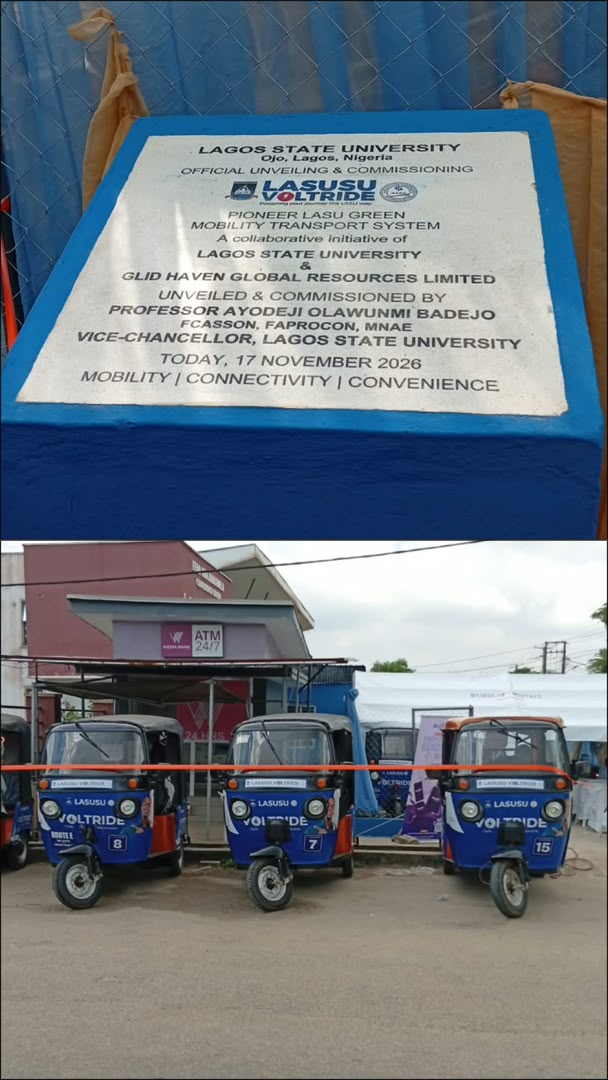
The Lagos State University Students’ Union (LASUSU) has introduced Voltride, an electric vehicle transportation initiative aimed at promoting sustainable campus mobility, creating employment opportunities and encouraging technological innovation within the university community.
The project was a collaborative initiative between Lagos State University and Glid Haven Global Resources Limited. It was introduced by Mr Oluwatayo Olowe, an alumnus of Lagos State University, and the Junior Chamber International Nigeria, Lagos State University (JCIN-LASU), who highlighted the project’s long-term vision of making LASU a reference point for sustainable campus transportation across Nigerian universities.
The LASUSU Voltride was officially unveiled and commissioned on Tuesday, 17th November, 2026, by the University’s Vice-Chancellor, Professor Ayodeji Olawunmi Badejo, FCASSON, FAPROCON, MNAE, represented by the Dean of Student Affairs, Dr Abiodun Fatai Abatan, at the Voltride charging station beside the Femi Gbajabiamila Hall, LASU, Ojo.
The project is promoted by the directors of Human Resources Limited (HRL) and is already creating employment and professional opportunities for young graduates and undergraduates of the university. It has engaged fresh graduates, particularly those from the School of Transport and Logistics and the Department of Computer Science, as well as university graduates awaiting their National Youth Service Corps (NYSC) deployment.
According to the promoters, the initiative is more than a business venture; it is an opportunity to position the university as an active participant in shaping the future of transportation and technological development in Nigeria.
The promoters further expressed their commitment to expanding these opportunities as the project develops, emphasising the importance of investing in the talents and human resources within the university community.
The initiative also aligns with the Federal Government’s policy direction towards the adoption of electric vehicles (EVs) and compressed natural gas (CNG)-powered vehicles in Nigeria. This development is expected to contribute to more efficient, accessible, cost-effective, and environmentally sustainable transportation while encouraging local investment, technology transfer, and the growth of the Nigerian automotive industry.
As private-sector participants, the promoters expressed their support for the government’s direction, noting their commitment to complementing existing efforts through practical solutions that create economic value and opportunities.
Beyond the immediate transportation benefits, the promoters revealed a broader vision for LASU. Subject to the necessary approvals and collaboration with the Governing Council, Vice-Chancellor, and university management, they hope to establish an electric vehicle assembly and innovation centre within the university.
The proposed centre is expected to expose students to emerging areas of technology, including electric vehicle technology, battery systems, software development, engineering, vehicle assembly, and intelligent transportation solutions. It will also provide opportunities for research, practical learning, and industry exposure, positioning LASU as an active contributor to Nigeria’s growing mobility industry.
Emphasising the importance of student participation, the promoters noted that students should not only benefit from technological advancements but also be actively involved in creating them.
Ultimately, LASUSU Voltride demonstrates the possibilities that can emerge when institutional leadership, government support, and private-sector partnerships work together towards a common goal of sustainable development and innovation.


 lasuconscience
 Aina Oluwanifesimi, Correspondent, LASU Conscience